


RX-Cargo
Designed for Heavy Stuff
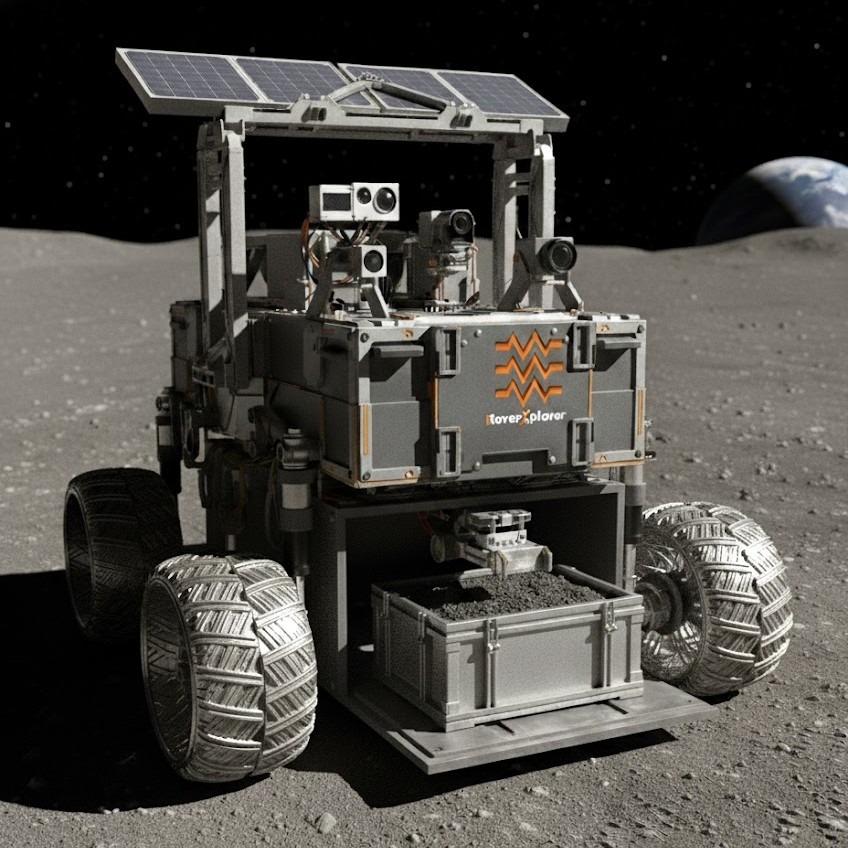
Artistic view of the RX-Cargo rover
RX-Cargo: Moving to the Next Level
The R-Cargo represents the “SCALE” phase of our architecture. It will answer the next critical question in exploration: “Now that we're on the Moon, how do we build?”
The RX-Cargo evolves our validated platform into a logistical “workhorse.” To do this, we are deliberately changing the paradigm: the constraint is no longer mass (< 30 kg), but transport capacity and industrial reliability.
1. Scaling Up: Logistical Capacity
The RX-Cargo is an Autonomous Logistics Transport System (ATLS).
Load Capacity: It is designed to carry a nominal payload of 50 kg, which is 25 times more than our scientific platforms.
Modular Interface: It replaces the scientific interface with a loading platform capable of transporting regolith or equipment modules.
Increased Power: To handle this mass (< 150 kg dry, < 200 kg loaded), the energy architecture is five times greater, with a battery capacity of > 1 kWh.
2. The Evolution of Autonomy: Level L4
For logistics, L3 autonomy (local avoidance) is not enough. The RX-Cargo is designed for Level L4 autonomy: high autonomy on defined routes.
Our Solution: The RX-Cargo is capable of performing repeatable logistics shuttles (e.g., Lander <-> Base) over more than 1 km. It manages “route tracking” and “position maintenance” for loading/unloading, ensuring a predictable and efficient logistics flow.
3. Reliability as a Goal
An industrial tool must operate without interruption. The RX-Cargo is designed for high availability, with a target Mean Time Between Failures (MTBF) of over 2,000 hours of operation.
It retains the survival DNA of the RX-Moon, including cryogenic survival thanks to RHUs and radiation tolerance of 100 kRad (Si), ensuring that our “workhorse” is just as resilient as our explorers.
The RX-Cargo is proof that our architecture is ready to build the lunar economy.